
Giant whales move into Greenland waters as ice disappears

                                                   From - BBC World News
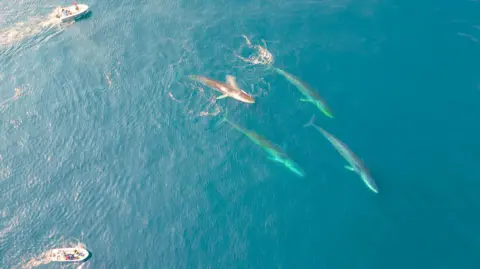

Fernando Ugarte The image is captured from above by a drone. In the right side of the image,  four huge fin whales - their long bodies fully visible in the clear blue water - swim in a group. Two small research boats are dwarfed by the marine mammals, as they observe from a safe distance - they are in the top and bottom left corners of the image. Fernando Ugarte
Fin whales feed in ice-free East Greenland waters, as scientists observe from their boats

Sea ice has been disappearing from East Greenland, allowing giant whales to take advantage and move in to previously inaccessible areas.

That is the conclusion of a decades-long study that has recorded - and filmed - hundreds of the world's biggest whales including humpbacks, minke and fin whales, feeding in ice-free seas along the coast in summer.

None of these marine mammals were historically found here as they have been locked out of the coastal waters by ice. Now, as climate change warms the sea and melts that ice, they have adapted.

Scientists describe the result as seasonal Arctic "feeding frenzies" - part of a major regime shift in the ocean environment along East Greenland.
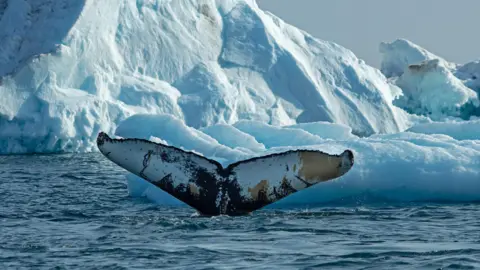
Fernando Ugarte The image shows a humpback whale fluke emerging from blue, slightly choppy waters with icebergs in the background. This is a diving humpback whale, feeding among the broken sea ice of East Greenland.  Fernando Ugarte
A humpback whale feeding in coastal subarctic waters

The change is dramatic: ship-based surveys in the region did not record a single humpback whale sighting there until 2006.

In 2007, seven humpbacks were seen, and by 2024, there were 150 ship-based sightings of these giant whales.

The first systematic aerial surveys of baleen whales - a group that includes fin, minke and humpbacks - off the East Greenland coast were carried out by the researchers during the summers of 2015 and 2024.

They combined that information with the tracks of 15 satellite-tagged whales and testimony from Inuit hunters - all building a picture of what the lead researcher Prof Mads Peter Heide-Jørgensen called a "major ecological regime shift".

An estimated 4,000 humpback whales, 6,000 fin whales and 6,000 minke whales visited the Greenland Sea in the summer of 2024.
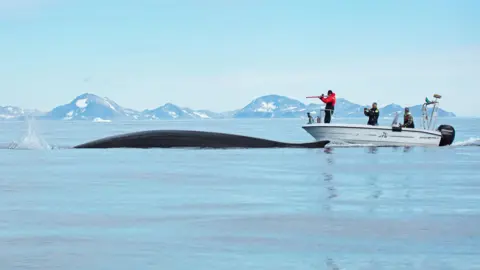
Fernando Ugarte The image shows a research vessel with three people aboard, approaching a huge fin whale which is swimming at the surface of calm water. The mountains of Greenland are visible in the background. The whale's dark, long, shining body and small dorsal fin are visible above the water line. A scientist stands at the front of the vessel with what looks like a gun. This is a satellite dart gun, which enables researchers to attach tracking devices to the skin of whales from a distance - without harming the animal. Fernando Ugarte
The researchers fitted satellite tracking devices to some whales to follow their seasonal movements

Prof Heide-Jørgensen, from the Greenland Institute of Natural Resources, told BBC News that the changes in the region were "probably the most radical we can see anywhere in the subarctic".

That shift is driven by rising sea temperatures and food availability. The whales appear to be feeding on fish that have moved into the warming waters of East Greenland.

They estimated that the three whale species would consume at least 800,000 tonnes of fish and krill during a summer feeding season.
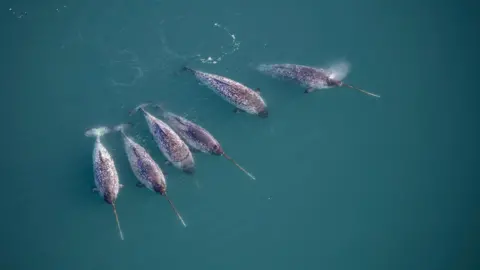
Carsten Egevang An aerial image shows six narwhals in open water - their bodies and tusks clearly visible just beneath the dark turquoise water. Carsten Egevang
While some whales are benefiting from warming waters, Arctic species like narwhals are losing habitat

It is not clear from this study whether the change reflects an overall increase in the populations of these whale species, or just a redistribution from other areas.

Other experts the BBC spoke to were concerned that the study suggested there was an influx of the animals from West Greenland. That is a sensitive issue in Greenland, a country where some whales are hunted.

But the scientists said that their findings do suggest that these "opportunistic" baleen whales appear to be adapting and might even be benefiting from the change.

Other Arctic species, however, are "in trouble now", explained Prof Heide-Jørgensen.

Animals including narwhals and belugas are sharing habitat with - or even being displaced by - these other whales.

"For some species, climate change is not necessarily a problem - it opens up new opportunities," said Prof Heide-Jørgensen, "but other species are losing their habitat".

The study is published in the journal Frontiers in Marine Science.

Comments

Popular posts from this blog

Who Was the Real Marilyn Monroe?

  From - Smithsonian Magazine, By -  Grant Wong Historian, University of South Carolina, Edited by - Vinuri Randhula  Silva, “Blonde,” a heavily fictionalized film by Andrew Dominik, explores the star’s life and legend in a narrative that’s equal parts glamorous and disturbing Marilyn Monroe’s  final interview  is a heartbreaker. Published in  Life  magazine on August 3, 1962—just a day before the  actress died  of a barbiturate overdose at age 36—it found Monroe reflecting on her celebrity status, alternatively thoughtful, frank and witty. “When you’re famous you kind of run into human nature in a raw kind of way,” she observed. “It stirs up envy, fame does. People you run into feel that, well, who is she—who is she, who does she think she is, Marilyn Monroe?” That same question—who was the real Monroe?—has sparked debate among  cinema scholars ,  cultural critics ,  historians ,  novelists ,  filmmakers  and th...

New Comet SWAN Now Visible in Small Scopes

     From :- Sky & Telescope  By :- Bob King  Edited by :- Amal Udawatta This spectacular image of Comet SWAN (C/2025 F2) was taken on April 6th and shows a bright, condensed coma 5′ across and dual ion tails. The longer one extends for 2° in PA 298° and the other 30′ in PA 303°. Details: 11"/ 2.2 RASA and QHY600 camera. Michael Jaeger Amateur astronomers have done it again — discovered a comet. Not by looking through a telescope but through close study of  publicly released, low-resolution images  taken by the  Solar Wind Anisotropies  (SWAN) camera on the orbiting  Solar and Heliospheric Observatory  (SOHO). On March 29th, Vladimir Bezugly of Ukraine was the first to report a moving object in SWAN photos taken the week prior. Michael Mattiazzo of Victoria, Australia, independently found "a pretty obvious comet" the same day using the same images, noting that the object was about 11th magnitude and appeared to be brightening. R...

Geckos shed around every month in adulthood

 From -Earth Unreal, Edited -by Vinuri Randula Silva, All geckos shed their skin at fairly regular intervals, with different species differing in timing and method. When shedding begins, geckos accelerate the process by detaching the loose skin from their body and eating it.   Geckos shed around every month in adulthood, and will often eat their shed skin. This is to gain back some of the nutrients they lose by shedding, and also to avoid being detected by predators in the wild.