
Tyrannosaurus rex most expensive dinosaur ever sold


                                                                From:- BBC World News

                                                                By:- Esme Stallard  -  Climate and science reporter                                                                   Edited by  :- Amal Udawatta
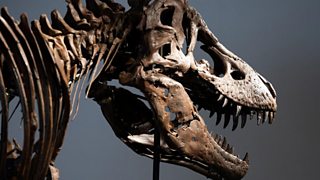

Tyrannosaurus rex fossil sells for record price at auction

A 67 million-year-old Tyrannosaurus rex has been sold for £37.4m ($50.1m) at a Sotheby's auction in New York - the most ever paid for a dinosaur.

The fossil of this infamous predator stands more than 12 feet (4m) tall, and with over 60% of its bones recovered is one of "the most complete" specimens ever found, according to Sotheby's.

The winning bidder at the sale on Tuesday has not yet been disclosed.

Gus, as the T. rex has been affectionately named, was discovered in 2021 on a remote ranch in the US State of South Dakota.
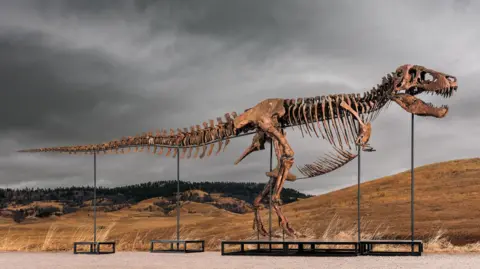
Matthew Sherman An T. rex skeleton with some rib bones missing stands on a pedestal held up by five metal bars. In the background is rolling brown hills and forest. The sky has thick grey clouds.Matthew Sherman

"This result has been years in the making," said Cassandra Hatton, Sotheby's worldwide head of science and natural history.

"Gus is not only an exceptional find, but a specimen that's been excavated, documented, prepared, and cared for with real excellence."

The sale exceeded the previous record set by a stegosaurus in 2024, and is the first to exceed the $50m benchmark.

Some scientists have told the BBC that the auction may herald a new era in fossil collecting by the ultra-rich.
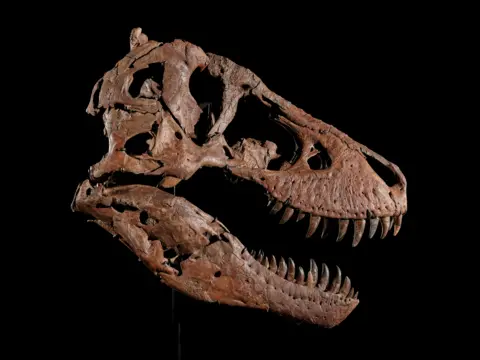
Matthew Sherman A T. rex skull brown in colour against a black backdrop. The mouth is slightly ajar. Matthew Sherman
The skull indicated a life of danger for the T. rex nicknamed Gus

Hatton says the price paid reflects the time and resources that went into uncovering the specimen.

The bones were excavated over three summers, when it was warm enough for the ground to have thawed, from 2021 to 2023.

But it took a further three years in the lab to piece the T. rex back together.

This work revealed the skull had bite marks, and previously broken ribs that had healed in its lifetime.

Both injuries were potentially sustained during scavenging or during a battle with other dinosaurs.

It may be some time before the buyer is revealed, but Apex, the stegosaurus who held the last record, was loaned out to the American Museum of Natural History for four years by its billionaire-owner Kenneth Griffin.

So, even if Gus has attracted an ultra-wealthy buyer it still might be coming to a museum near you soon.


Comments

Popular posts from this blog

Who Was the Real Marilyn Monroe?

  From - Smithsonian Magazine, By -  Grant Wong Historian, University of South Carolina, Edited by - Vinuri Randhula  Silva, “Blonde,” a heavily fictionalized film by Andrew Dominik, explores the star’s life and legend in a narrative that’s equal parts glamorous and disturbing Marilyn Monroe’s  final interview  is a heartbreaker. Published in  Life  magazine on August 3, 1962—just a day before the  actress died  of a barbiturate overdose at age 36—it found Monroe reflecting on her celebrity status, alternatively thoughtful, frank and witty. “When you’re famous you kind of run into human nature in a raw kind of way,” she observed. “It stirs up envy, fame does. People you run into feel that, well, who is she—who is she, who does she think she is, Marilyn Monroe?” That same question—who was the real Monroe?—has sparked debate among  cinema scholars ,  cultural critics ,  historians ,  novelists ,  filmmakers  and th...

New Comet SWAN Now Visible in Small Scopes

     From :- Sky & Telescope  By :- Bob King  Edited by :- Amal Udawatta This spectacular image of Comet SWAN (C/2025 F2) was taken on April 6th and shows a bright, condensed coma 5′ across and dual ion tails. The longer one extends for 2° in PA 298° and the other 30′ in PA 303°. Details: 11"/ 2.2 RASA and QHY600 camera. Michael Jaeger Amateur astronomers have done it again — discovered a comet. Not by looking through a telescope but through close study of  publicly released, low-resolution images  taken by the  Solar Wind Anisotropies  (SWAN) camera on the orbiting  Solar and Heliospheric Observatory  (SOHO). On March 29th, Vladimir Bezugly of Ukraine was the first to report a moving object in SWAN photos taken the week prior. Michael Mattiazzo of Victoria, Australia, independently found "a pretty obvious comet" the same day using the same images, noting that the object was about 11th magnitude and appeared to be brightening. R...

Geckos shed around every month in adulthood

 From -Earth Unreal, Edited -by Vinuri Randula Silva, All geckos shed their skin at fairly regular intervals, with different species differing in timing and method. When shedding begins, geckos accelerate the process by detaching the loose skin from their body and eating it.   Geckos shed around every month in adulthood, and will often eat their shed skin. This is to gain back some of the nutrients they lose by shedding, and also to avoid being detected by predators in the wild.