From :- BBC World News
By :- Sophie Hardach
Edited by :- Amal Udawatta
 Vladimír Čech Jr
Wildcats are so elusive, they were thought to be extinct in parts of Europe. But they are making a comeback in some areas – and photographers and scientists are capturing unprecedented images of them.
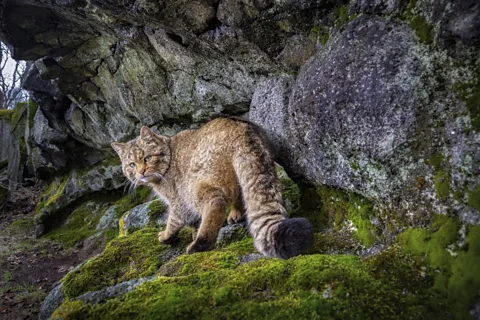
In 2020, wildlife photographer Vladimír Čech Jr was trudging through the snow in a military zone in the Doupov Mountains, a remote and rugged area in the Czech Republic. His goal: to take photos of the European wildcat, a species so elusive, it had been thought to be extinct in several European regions.
"The wildcat is a rare creature living a life full of riddles," says Čech of the wildcat, which looks a bit like a stouter, bushier-tailed version of a tabby housecat, with its own distinctive pattern.
Once thought to have vanished from the Czech Republic in the 20th Century, wildcats had been documented in the Doupov Mountains in the late 2010s by simple trail cameras – but no one had ever taken high-quality images of them in the area.
In recent years, scientists and photographers using camera traps have also spotted the wildcat in other parts of Europe, where its elusiveness may have helped it secretly survive the historical persecution by hunters that erased other wild species, such as the lynx. There are thought to be about 140,000 European wildcats (Felis silvestris), spread across more than two dozen countries. Reliable estimates are difficult because the cat is so shy: in some places where it was considered lost, such as Austria, camera traps have proven its presence.
"[The wildcat] is considered 'the ghost of the forests' because it's very, very elusive, and it's hard to predict where it can be spotted," says Andrea De Giovanni, an Italian biologist and wildlife photographer who shot a video of a wildcat in Chiapporato, an abandoned village in the Apennine mountains in Italy, in 2020.
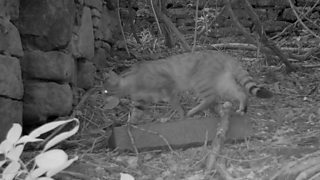
Based on his observations, De Giovanni suspects the wildcat moves less predictably than other species, making it harder to spot: "Other animals tend to follow the same trails through the forest. The wildcat goes wherever she wants to."
De Giovanni hadn't actually planned to film a wildcat in the ghost village. "I'd never even thought of taking photos of wildcats, for a simple reason: I thought it was impossible, or at least, extremely difficult," he says, given their shyness and unpredictability. Instead, he'd hoped to capture images of wolves or deer in the village, and had set up a hidden camera trap opposite one of the abandoned houses.
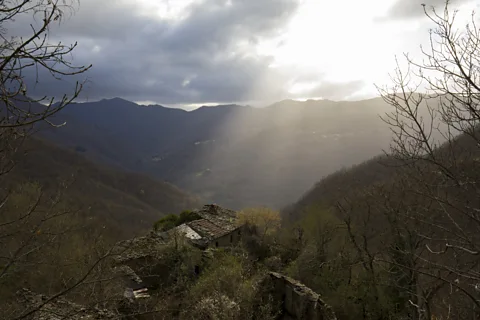
The crumbling, abandoned village of Chiapporato is a mysterious place, only reachable on foot. Among the human belongings still scattered in the ruins, De Giovanni found an exercise book from the 1950s, in which a child described how they imagined space travel. In winter, he spotted wolf and deer tracks in the village's snowy alleys.
When he saw the slinking animal in the video, he initially wasn't sure whether it was a wildcat or domestic cat, and sent the footage to scientists who identified it as a wildcat.
 Vladimír Čech Jr
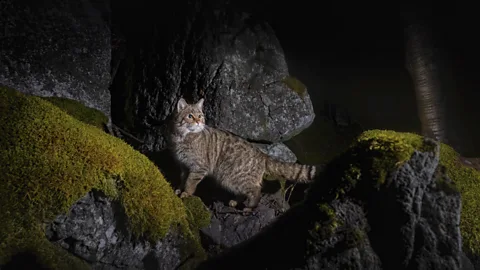
For Čech, the photographer operating in the remote Czech military zone, capturing images of the wildcat also involved adventure and ingenuity. For decades, the wildcat had been considered lost, and had only recently been documented in the area at all.
"Historically, the wildcat was widespread across the entire territory of what is now the Czech Republic, at least until the 18th Century," says Jarmila Krojerová, a zoologist and wildcat expert at the Institute of Vertebrate Biology of the Czech Academy of Sciences. "Due to intensive persecution and landscape changes, it gradually disappeared from lowlands and later also from mountain regions. The last confirmed individual was reported shot in 1952, likely near the border regions."
Modern records of the wildcat in the Czech Republic begin only in 2011, when a wildcat was captured by a camera trap set up to take pictures of lynxes in the Šumava Mountains, she says. Since then, there have been occasional records, Krojerová says, but there was little systematic knowledge until wildcat expert Jiri Sochor began more detailed monitoring in the Doupov Mountains.
With permission from the military, Čech set out together with Sochor to try and get higher-quality images.
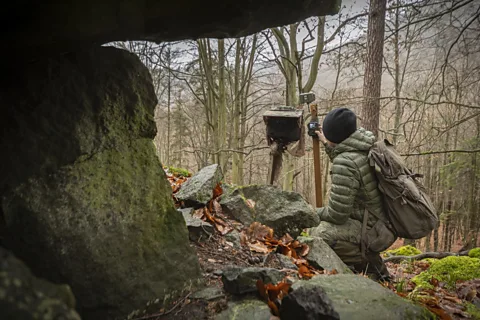
"I decided to build my own [camera] trap," says Čech, by combining a camera, a remote control, a sensor and other components. "I built my photo studio in the middle of the forest."
 Vladimír Čech Jr
Photos like those taken by Čech are very valuable for conservation, Krojerová says: "They help raise public awareness, communicate the presence and beauty of this elusive species, and serve as a powerful tool for biodiversity conservation outreach."
Krojerová and her team have researched wildcats along the Czech-Slovak border and in western Bohemia, including the Doupov area, using camera traps and lure sticks treated with valerian tincture to collect samples. "Individual wildcats can then be identified either by their unique genotype or by their coat pattern," she says.
The wildcats' secretive behaviour makes them challenging to study, she explains. In addition, their similarity to tabby cats often leads to "misidentification or the species being overlooked entirely", she says.
In Italy, Andrea Sforzi, a wildcat expert and the director of the Maremma Natural History Museum in Grosseto, runs a database with his team that has gathered around 1,600 photos and videos of the wildcat, submitted by scientists, photographers, and members of the public.
"In some areas of Italy, the species is expanding," he says – such as in the Northern range of the Apennine Mountains, where De Giovanni filmed the wildcat. Historically, the wildcat and other carnivores were hunted in Italy, but starting in the late 20th Century, conservation laws put the species under protection and helped it recover, he explains.
 Andrea De Giovanni
Documenting this recovery involves venturing into places as mysterious as the wildcat.
"It's a strange, fascinating place," De Giovanni says of Chiapporato, the abandoned village where he captured the wildcat sneaking into a house. It was once inhabited by lumberjacks and charcoal burners, who had neither running water nor electricity.
By the time De Giovanni began visiting it, the elderly villagers had died, and the young ones had moved to better connected villages and towns. Today, "nature is devouring this village", he says.
For De Giovanni, the images of Chiapporato illustrate a wider process of abandonment.
"It's a phenomenon we talk about a lot in Italy: the mountains are being abandoned, people are moving to the cities, and some traditional activities linked to mountain life such as logging or chestnut cultivation are declining, so there's no reason to live in the mountains," he says. "Chiapporato is emblematic of that process, because as humans abandon the mountains, other species return – such as the wolf and the wildcat."
Sforzi, who identified the animal in De Giovanni's footage as a wildcat based on its appearance, says that for a full identification, a genetic analysis would be needed, based on hair samples – which again, are tricky to obtain from the elusive wildcat, even with lure sticks.
"Not all wildcats are attracted by the sticks, and of those attracted, not all rub against it," Sforzi says. "Of those who rub against it, not all leave hairs – and if they leave hairs, not all of the hairs have a hair bulb, which is where the DNA is."
When he received De Giovanni's video, it was one of very few images of wildcats in that area. "It was interesting because it was one of the first from that area, and it was a good image and clear enough to see the visual characteristics," Sforzi says.
More like this:
• The polar bears living on a Russian 'ghost island'
• The maritime lions hunting seals on the beach
• Seven quiet wins for climate and nature in 2025
The wildcat has a distinctive striped pattern, Sforzi explains, similar to domestic tabby cat but with crucial differences. For example, the wildcat has a stripe along its spine. While a tabby cat has black or brown stripes all over, the wildcat has black stripes on its back and tail, and more faded, lighter ones on its side and legs. Interbreeding between wildcats and domestic cats is one of the threats to the wildcats, firstly because it results in hybrids, and secondly, because domestic cats can pass on diseases that are dangerous for wildcats, says Sforzi.
Since the video, separate research has also documented wildcats' presence in the area around Chiapporato with hair samples and genetic analysis. While wildcats would usually avoid human settlements, in the case of Chiapporato, "it's a ghost village – and for the wildcat, by now, it's part of the forest, like the hollow tree trunks and rocks that it uses as shelter," says Sforzi.
Vladimír Čech JrThis year, the Czech research team, which includes Čech and Sochor, has used GPS telemetry, a method that involves capturing the cats, fitting them with radio collars, then releasing them and monitoring their movements.
"[We] captured the first male wildcat in the Czech Republic in the Hradiště military district in the Doupov Mountains at the end of February 2025," and experts then fitted him with a telemetric collar, says Čech. "The data obtained will help us better understand their behaviour and the requirements they have for the environments they inhabit," he adds.
"Our data show that home ranges are much larger than previously assumed," Krojerová says, and can span dozens of square kilometres. "Telemetry also demonstrates that the wildcat is not primarily a forest species, as traditionally thought, but depends on a mosaic landscape combining forests, meadows, pastures and clearings."
Other researchers have also seen successes, thanks to new methods. In Austria, where wildcats were thought to be extinct, scientists documented them thanks to camera traps and genetic analysis of hair samples from lure sticks. These rough wooden sticks – sometimes equipped with sticky tape, Velcro, or a brush – attract wildcats with a scented bait. The wildcats then rub themselves against the sticks, leaving hairs.
At times, the animals hide in plain sight.
Wildcat hybrids have shown up mingling undetected among housecats around farms in Hungary.
In an animal shelter in Germany, a seemingly abandoned, unusually fierce kitten turned out to be a wildcat, according to media reports.
For Čech, the research and the photos document an animal that was long overlooked, and was in the shadow of larger carnivores such as the wolf, bear and lynx, but that is fascinating in its own right. "It is an uncompromising hunter and a perfectly camouflaged predator in its natural environment," he says, of the wildcat, welcoming its recovery: "After several decades, this mysterious little beast is returning to our forests."
Comments
Post a Comment