New monkey species with orange lips found 'hiding' in DR Congo forest


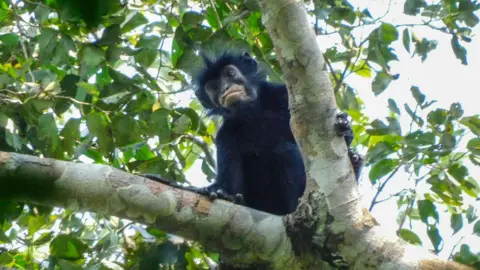
Junior Amboko The image shows a newly discovered species of monkey looking down towards the camera from the branch of a leafy tree, in the forests of the Democratic Republic of Congo. The monkey has black fur and a black face with particularly striking pinkish-orange lips. Junior Amboko
The monkey, known locally as "Likweli", has distinctive pinkish-orange lips

A monkey that has striking pinkish-orange lips and a black face - and lives in the forests of the Democratic Republic of Congo - has been confirmed as a new species to science.

The black-furred primate was spotted and photographed hidden away in the high tree canopy of dense tropical forests in Lomami National Park, in the central east of the country.

Conservationists working there first reported seeing this unusual-looking animal back in 2008. But they captured just one blurry photograph.

After another sighting 10 years later, an international team set out to find and study the monkey and revealed that it was a previously unknown species.

This is only the fifth African monkey species to be discovered in the last 75 years.

Junior Amboko, a PhD student at Florida Atlantic University, played a leading role in the search, which involved audio recordings, photography and detailed genetic studies.

The findings were published in the journal PLoS One.

Amboko told BBC News it was an "amazing feeling" to look into the face of an animal that so few people knew existed.

Secretive species
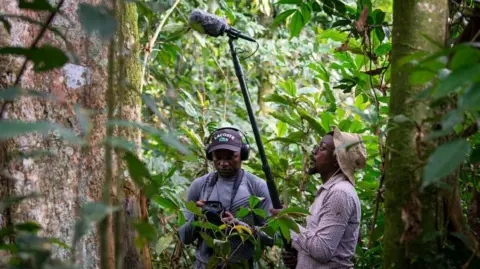
Daniel Rosengren Two researchers, one holding a microphone on a long pole, and one carrying a recording device, work in the dense rainforest to capture the call of the Colobus congoensis monkey. Daniel Rosengren
Junior Amboko (left) and Mardoché B. Koko recorded the distinctive, resonant roar of the newly discovered Colobus congoensis monkey in the Lomami National Park, DR Congo

"Discovering" a species, in this context, means officially recording and confirming it has evolved to be genetically distinct. Some local people already knew of the monkey's existence and refer to it by a common name - Likweli.

But Amboko said the monkeys were "kind of shy" - and tended to hide high in the trees.

"As part of our search, we interviewed people in 52 villages close to where the animals live. And only people in eight villages [had ever seen] them," he recalled.

The research team - from DR Congo, the US and Germany - gave the animal the Latin name Colobus congoensis in recognition of the natural diversity in the country.

It belongs to the larger group of colobus monkeys. "These are really important African monkeys that don't have thumbs," explained Prof Kate Detwiler from Florida Atlantic University.
The Likweli monkey's distinctive roaring call. Credit Bernard Bonanga, CC-BY 4.0

"They're these herbivores of the canopy that are a critical part of the ecosystem. We think they have a lot to do with processing seeds and germination in the forest."

Prof Detwiler speculates that their unusual, bright facial markings could be a visual signal to other animals, potentially attractive to a mate or that it could allow the animals to identify each other.

The monkeys also have a distinctive "roaring" call. "You often hear them, but don't see them," said Amboko.

They think the animals are rare and restricted to a part of the forest where they can find the food and habitat they need.

The animals are hunted for meat, so the researchers hope that now that Colobus congoensis is classified as a distinct species it can be officially protected.

The researchers say they still have a lot of questions about this newly described, secretive species. They plan to carry out a more detailed survey to estimate their population and study their behaviour.

Comments

Popular posts from this blog

Who Was the Real Marilyn Monroe?

  From - Smithsonian Magazine, By -  Grant Wong Historian, University of South Carolina, Edited by - Vinuri Randhula  Silva, “Blonde,” a heavily fictionalized film by Andrew Dominik, explores the star’s life and legend in a narrative that’s equal parts glamorous and disturbing Marilyn Monroe’s  final interview  is a heartbreaker. Published in  Life  magazine on August 3, 1962—just a day before the  actress died  of a barbiturate overdose at age 36—it found Monroe reflecting on her celebrity status, alternatively thoughtful, frank and witty. “When you’re famous you kind of run into human nature in a raw kind of way,” she observed. “It stirs up envy, fame does. People you run into feel that, well, who is she—who is she, who does she think she is, Marilyn Monroe?” That same question—who was the real Monroe?—has sparked debate among  cinema scholars ,  cultural critics ,  historians ,  novelists ,  filmmakers  and th...

New Comet SWAN Now Visible in Small Scopes

     From :- Sky & Telescope  By :- Bob King  Edited by :- Amal Udawatta This spectacular image of Comet SWAN (C/2025 F2) was taken on April 6th and shows a bright, condensed coma 5′ across and dual ion tails. The longer one extends for 2° in PA 298° and the other 30′ in PA 303°. Details: 11"/ 2.2 RASA and QHY600 camera. Michael Jaeger Amateur astronomers have done it again — discovered a comet. Not by looking through a telescope but through close study of  publicly released, low-resolution images  taken by the  Solar Wind Anisotropies  (SWAN) camera on the orbiting  Solar and Heliospheric Observatory  (SOHO). On March 29th, Vladimir Bezugly of Ukraine was the first to report a moving object in SWAN photos taken the week prior. Michael Mattiazzo of Victoria, Australia, independently found "a pretty obvious comet" the same day using the same images, noting that the object was about 11th magnitude and appeared to be brightening. R...

Geckos shed around every month in adulthood

 From -Earth Unreal, Edited -by Vinuri Randula Silva, All geckos shed their skin at fairly regular intervals, with different species differing in timing and method. When shedding begins, geckos accelerate the process by detaching the loose skin from their body and eating it.   Geckos shed around every month in adulthood, and will often eat their shed skin. This is to gain back some of the nutrients they lose by shedding, and also to avoid being detected by predators in the wild.