
NASA used a drone to deliver a human kidney. Is this the future of transplant transport?

   From : Space.com

   By :   

   Edited by : Amal Udawatta

a large quadcopter drone flies in front of a clear, blue sky
NASA researchers conduct the first-of-its-kind organ transport drone test with a human kidney on June 5, 2026 at Langley Research Center in Hampton, Va. (Image credit: NASA/Ryan Hill)
The drone flew beyond line of sight with a kidney not viable for organ transplant, to test the concept for future deliveries to patients.

NASA is hoping to use drones to speed up organ delivery for transplant patients.

A flight test earlier this month at NASA's Langley Research Center in Virginia saw a drone pick up a kidney and fly it for the first time beyond "line of sight", or the distance from which a drone is visible by an operator. Keeping a line of sight on a drone is a typical requirement for flight safety, but NASA is developing tools that may allow these machines to fly further away from operators in populated environments more regularly.

The kidney on the June 5 flight test was not viable for organ transplantation, which is why the agency and partner United Network for Organ Sharing were able to use it, according to WTKR. If all goes to plan with future tests conducted with NASA Langley, however, UNOS aims to fly organ-bearing drones as far as 15 miles (24 km), in between hospitals for example, to allow for swift and safe delivery to waiting patients. The drone collaboration was created to "explore faster, more reliable ways to transport donor organs using advanced aviation technologies", according to space agency materials published in April.

Drones may have a better ability than larger aircraft to navigate ground logistics or maneuver in dense or hard-to-reach delivery areas. What's more, drones might be able to do so faster than aircraft, which is crucial: organs can only last so long during transportation.

The test used additional radios on the drones intended to allow pilots to keep an eye on the drones even while out of sight. "What that means, more or less, is we're going to have the pilot in command be about a mile away inside of a control room," Kyle Smalling, an aerospace engineer at NASA Langley, told WAVY.com.
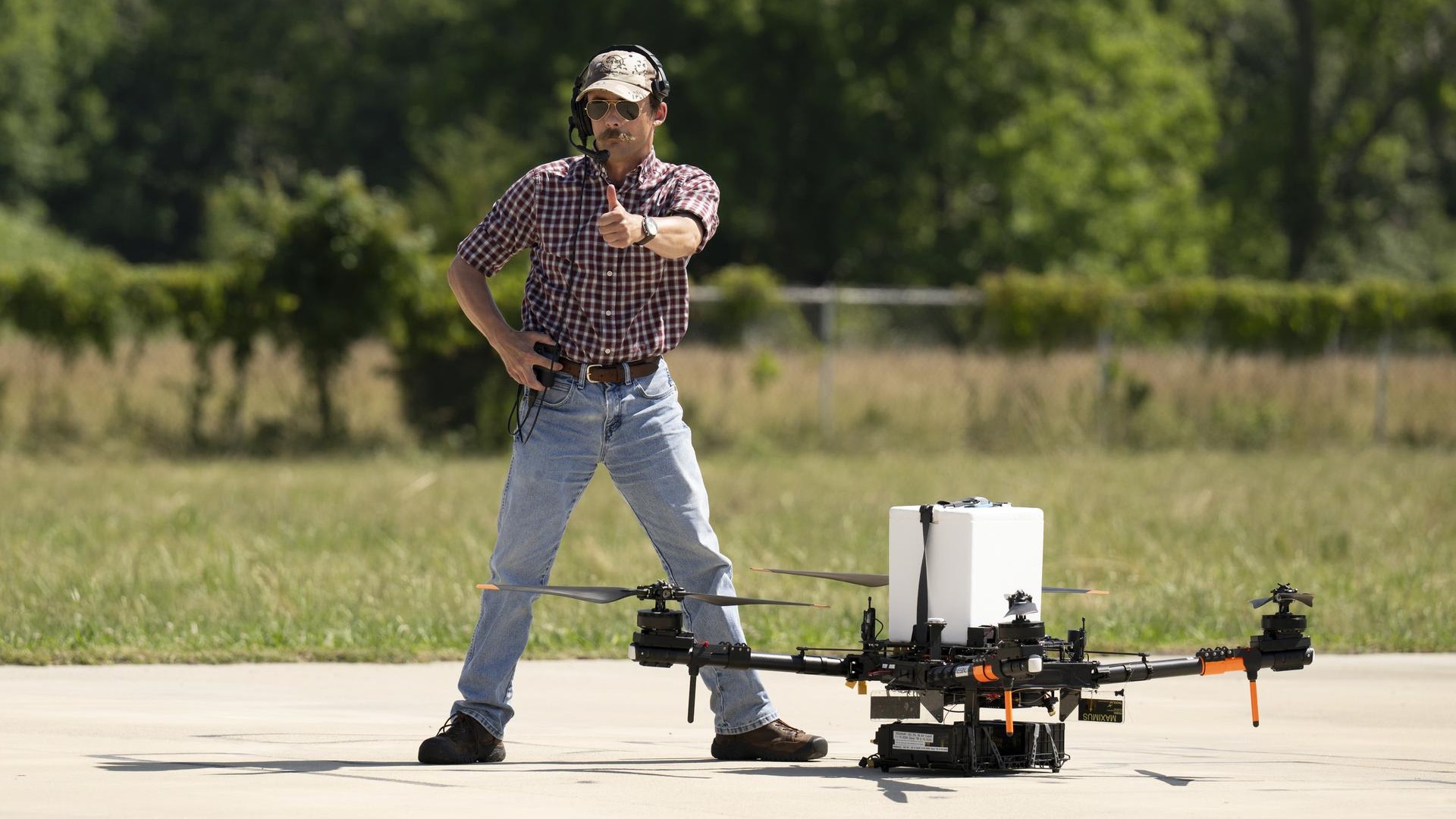
a man with a formidable mustache gives a thumbs up next to a large quadcopter drone resting on a tarmac, with a rectangular white cooler strapped to it

NASA Langley partnered with UNOS, a non-profit organization that manages the U.S. organ transplant system, to conduct the first-of-its-kind organ transport drone test with a human kidney on June 5, 2026 at Langley Research Center in Hampton, Va. (Image credit: NASA/Ryan Hill)

Smalling added that this test met Federal Aviation Administration (FAA) requirements and took place on a NASA Langley flight range known as the City Environment Range Testing for Autonomous Integrated Navigation or CERTAIN, presumably for additional safety.

The flown kidney will eventually be assessed for "factors such as temperature stability and potential tissue damage caused by a lack of blood flow," NASA officials wrote in April about the June 5 flight test.

Beyond that, agency officials said they are hoping to explore "operational feasibility and scalability" for flying drones to patients as a "last-mile service" from a long-distance delivery, sort of in a similar way to how Amazon may be bringing packages to doors after initial shipment by truck.

"This is a chance to apply NASA Langley technology to a real-world problem that can save people's lives who are waiting for transplants," John Koelling, director of Langley's aeronautics research directorate, said in the statement.

"There's nothing more rewarding than seeing your technical work have a positive impact on people's lives."

Comments

Popular posts from this blog

Who Was the Real Marilyn Monroe?

  From - Smithsonian Magazine, By -  Grant Wong Historian, University of South Carolina, Edited by - Vinuri Randhula  Silva, “Blonde,” a heavily fictionalized film by Andrew Dominik, explores the star’s life and legend in a narrative that’s equal parts glamorous and disturbing Marilyn Monroe’s  final interview  is a heartbreaker. Published in  Life  magazine on August 3, 1962—just a day before the  actress died  of a barbiturate overdose at age 36—it found Monroe reflecting on her celebrity status, alternatively thoughtful, frank and witty. “When you’re famous you kind of run into human nature in a raw kind of way,” she observed. “It stirs up envy, fame does. People you run into feel that, well, who is she—who is she, who does she think she is, Marilyn Monroe?” That same question—who was the real Monroe?—has sparked debate among  cinema scholars ,  cultural critics ,  historians ,  novelists ,  filmmakers  and th...

New Comet SWAN Now Visible in Small Scopes

     From :- Sky & Telescope  By :- Bob King  Edited by :- Amal Udawatta This spectacular image of Comet SWAN (C/2025 F2) was taken on April 6th and shows a bright, condensed coma 5′ across and dual ion tails. The longer one extends for 2° in PA 298° and the other 30′ in PA 303°. Details: 11"/ 2.2 RASA and QHY600 camera. Michael Jaeger Amateur astronomers have done it again — discovered a comet. Not by looking through a telescope but through close study of  publicly released, low-resolution images  taken by the  Solar Wind Anisotropies  (SWAN) camera on the orbiting  Solar and Heliospheric Observatory  (SOHO). On March 29th, Vladimir Bezugly of Ukraine was the first to report a moving object in SWAN photos taken the week prior. Michael Mattiazzo of Victoria, Australia, independently found "a pretty obvious comet" the same day using the same images, noting that the object was about 11th magnitude and appeared to be brightening. R...

Geckos shed around every month in adulthood

 From -Earth Unreal, Edited -by Vinuri Randula Silva, All geckos shed their skin at fairly regular intervals, with different species differing in timing and method. When shedding begins, geckos accelerate the process by detaching the loose skin from their body and eating it.   Geckos shed around every month in adulthood, and will often eat their shed skin. This is to gain back some of the nutrients they lose by shedding, and also to avoid being detected by predators in the wild.