
Meet the 19-metre octopus that prowled the ancient seas


From :- BBC World News

By :- Helen Briggs  Science correspondent

Edited by :- Amal Udawatta
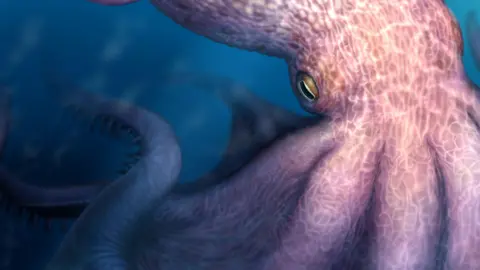
  Image: Yohei Utsuki, Department of Earth and Planetary Sciences, Hokkaido University The picture shows a large marble-pink octopus floating in a dark blue sea. It has large tentacles and is peering out of one yellow eye.

Image: Yohei Utsuki, Department of Earth and Planetary Sciences, Hokkaido University
A sketch of what the giant octopus might have looked like

Giant octopuses may have ruled the ancient oceans 100 million years ago, when dinosaurs roamed, according to new research.

Some of the earliest octopuses are believed to have been powerful predators equipped with strong arms for grabbing prey and beak-like jaws for munching on the shells and bones of other animals.

A new study of some remarkably well preserved jaws suggest they reached up to 19 metres, potentially making them the largest invertebrates ever known to scientists.

For decades, palaeontologists believed that the largest ocean predators were vertebrates with backbones such as fish and reptiles while invertebrates like octopuses and squid played supporting roles.
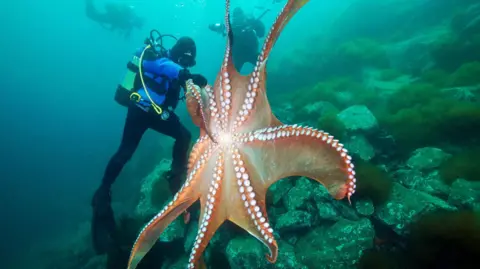
Getty Images A large octopus with outstretched arms showing a series of round tentacles rests on rocks against the backdrop of blue sea. Three divers swim close to the animal.Getty Images
A Giant Pacific Octopus meeting a diver on the ocean floor

New research by scientists from Hokkaido University in Japan challenges the picture scientists had of ancient octopuses.

Their analysis of fossil jaws suggests giant octopuses glided through the oceans equipped with the ability to chew on the hard shells and skeletons of large fish and marine reptiles.

The study estimates a body length of about 1.5 to 4.5 metres, which, when the long arms are included, comes to a total length of roughly 7 to 19 metres.

Even at the lower end of that range, the animal would have been enormous by today's standards.

Another striking feature is that the wear on the fossilised jaws is uneven from left to right, suggesting the animals may have favoured one side when feeding.

In living animals, favouring one side of the body over the other is linked to advanced brain function.
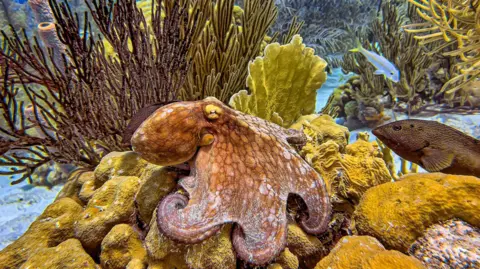
Getty Images A brown and yellow octopus sits on yellow-green rocks on the ocean floor as fish swim by.Getty Images
Octopuses are known for their extraordinary intelligence and for being masters of camouflage

Modern octopuses are known for their intelligence, problem solving and complex hunting strategies.

The Giant Pacific Octopus, the largest living species today, can have an arm span of more than 5.5 metres.

Video footage shows these animals taking on sharks more than a metre long.

"With their tentacles and their suckers they could perfectly hold on to such an animal and there is no escape," said Christian Klug, a palaeontologist at the University of Zurich, who reviewed the research.

However, many questions remain. Scientists can only guess at the exact shape of the animals, the size of the fins, or how quickly they could swim.

And no fossil has yet been found with stomach contents that would offer direct evidence of what they were dining on.

Dr Nick Longrich, a paleontologist at the University of Bath, said his hunch was that they were mainly preying on ammonites.

However, like the modern octopus, they would have been opportunistic and voracious predators, and wouldn't have passed up other prey if they had the chance.

"It's going to take a while before we figure this thing out," he said. "It's a bit of a mystery."

For now, the fossils offer a tantalising glimpse of a giant of the deep that may have roamed ancient seas, armed with a crushing jaw, powerful arms, and a brain that may have helped it compete with other top predators.

The research is published in the journal, Science.


Comments

Popular posts from this blog

Who Was the Real Marilyn Monroe?

  From - Smithsonian Magazine, By -  Grant Wong Historian, University of South Carolina, Edited by - Vinuri Randhula  Silva, “Blonde,” a heavily fictionalized film by Andrew Dominik, explores the star’s life and legend in a narrative that’s equal parts glamorous and disturbing Marilyn Monroe’s  final interview  is a heartbreaker. Published in  Life  magazine on August 3, 1962—just a day before the  actress died  of a barbiturate overdose at age 36—it found Monroe reflecting on her celebrity status, alternatively thoughtful, frank and witty. “When you’re famous you kind of run into human nature in a raw kind of way,” she observed. “It stirs up envy, fame does. People you run into feel that, well, who is she—who is she, who does she think she is, Marilyn Monroe?” That same question—who was the real Monroe?—has sparked debate among  cinema scholars ,  cultural critics ,  historians ,  novelists ,  filmmakers  and th...

New Comet SWAN Now Visible in Small Scopes

     From :- Sky & Telescope  By :- Bob King  Edited by :- Amal Udawatta This spectacular image of Comet SWAN (C/2025 F2) was taken on April 6th and shows a bright, condensed coma 5′ across and dual ion tails. The longer one extends for 2° in PA 298° and the other 30′ in PA 303°. Details: 11"/ 2.2 RASA and QHY600 camera. Michael Jaeger Amateur astronomers have done it again — discovered a comet. Not by looking through a telescope but through close study of  publicly released, low-resolution images  taken by the  Solar Wind Anisotropies  (SWAN) camera on the orbiting  Solar and Heliospheric Observatory  (SOHO). On March 29th, Vladimir Bezugly of Ukraine was the first to report a moving object in SWAN photos taken the week prior. Michael Mattiazzo of Victoria, Australia, independently found "a pretty obvious comet" the same day using the same images, noting that the object was about 11th magnitude and appeared to be brightening. R...

Geckos shed around every month in adulthood

 From -Earth Unreal, Edited -by Vinuri Randula Silva, All geckos shed their skin at fairly regular intervals, with different species differing in timing and method. When shedding begins, geckos accelerate the process by detaching the loose skin from their body and eating it.   Geckos shed around every month in adulthood, and will often eat their shed skin. This is to gain back some of the nutrients they lose by shedding, and also to avoid being detected by predators in the wild.