
NASA to Cover Progress 94 Spacecraft Launch, Space Station Docking

 From  :-  NASA

Edited by :-  Amal Udawatta
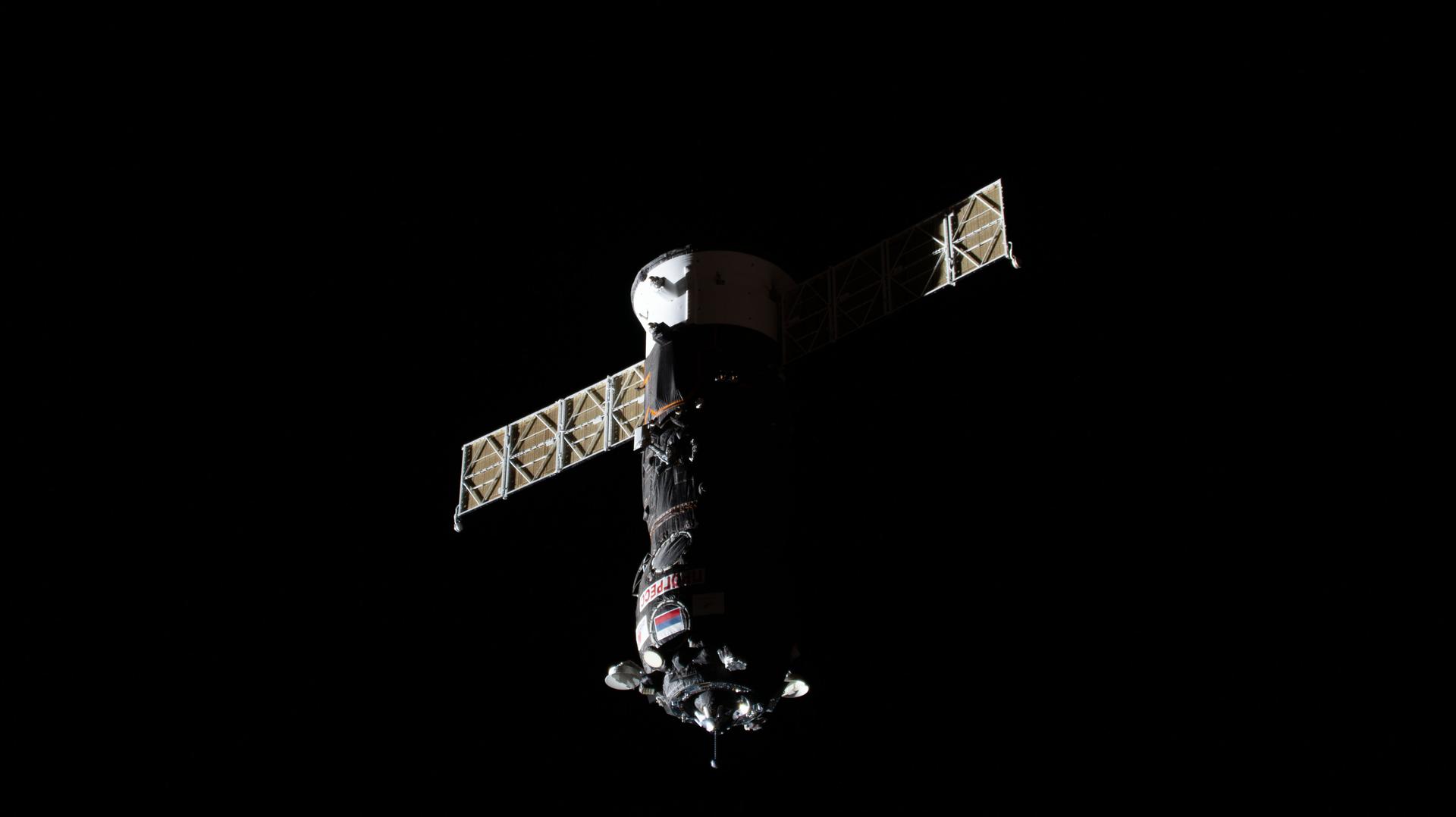
The Progress 92 cargo spacecraft, carrying nearly 3,000 pounds of food, fuel, and supplies for the Expedition 73 crew, approaches the International Space Station in July 2025 before docking to the Poisk module.
Credit: NASA

NASA will provide live coverage of the launch and docking of a Roscosmos cargo spacecraft carrying about three tons of food, fuel, and supplies for the crew aboard the International Space Station.

The unpiloted Roscosmos Progress 94 resupply spacecraft is scheduled to launch at 7:59 a.m. EDT (4:59 p.m. Baikonur time) Sunday, March 22, on a Soyuz rocket from the Baikonur Cosmodrome in Kazakhstan.

Watch NASA’s live coverage beginning at 7:30 a.m. on NASA+Amazon Prime, and the agency’s YouTube channel. Learn how to watch NASA content through a variety of online platforms, including social media.

After a two-day trip to the space station, the spacecraft will dock autonomously to the Poisk module’s space-facing port at about 9:34 a.m. Tuesday, March 24. NASA’s live rendezvous and docking coverage will begin at 8:45 a.m. on NASA+Amazon Prime, and the agency’s YouTube channel.

The Progress 94 spacecraft will remain docked to the orbiting laboratory for about six months before departing for a destructive re-entry into Earth’s atmosphere to dispose of trash loaded by the crew. Prior to this spacecraft’s arrival, Progress 92 undocked from the space station on March 16, re-entered Earth’s atmosphere, and burned up harmlessly over the Pacific Ocean.

For more than 25 years, people have lived and worked continuously aboard the International Space Station, advancing scientific knowledge and making research breakthroughs that aren’t possible on Earth. The space station helps NASA understand and overcome the challenges of human spaceflight, expand commercial opportunities in low Earth orbit, and build on the foundation for long-duration missions to the Moon as part of the Artemis program and to Mars. 

Joshua Finch / Jimi Russell
Headquarters, Washington
202-358-1100
joshua.a.finch@nasa.gov / james.j.russell@nasa.gov

Sandra Jones
Johnson Space Center, Houston
281-483-5111
sandra.p.jones@nasa.gov

Comments

Popular posts from this blog

Who Was the Real Marilyn Monroe?

  From - Smithsonian Magazine, By -  Grant Wong Historian, University of South Carolina, Edited by - Vinuri Randhula  Silva, “Blonde,” a heavily fictionalized film by Andrew Dominik, explores the star’s life and legend in a narrative that’s equal parts glamorous and disturbing Marilyn Monroe’s  final interview  is a heartbreaker. Published in  Life  magazine on August 3, 1962—just a day before the  actress died  of a barbiturate overdose at age 36—it found Monroe reflecting on her celebrity status, alternatively thoughtful, frank and witty. “When you’re famous you kind of run into human nature in a raw kind of way,” she observed. “It stirs up envy, fame does. People you run into feel that, well, who is she—who is she, who does she think she is, Marilyn Monroe?” That same question—who was the real Monroe?—has sparked debate among  cinema scholars ,  cultural critics ,  historians ,  novelists ,  filmmakers  and th...

New Comet SWAN Now Visible in Small Scopes

     From :- Sky & Telescope  By :- Bob King  Edited by :- Amal Udawatta This spectacular image of Comet SWAN (C/2025 F2) was taken on April 6th and shows a bright, condensed coma 5′ across and dual ion tails. The longer one extends for 2° in PA 298° and the other 30′ in PA 303°. Details: 11"/ 2.2 RASA and QHY600 camera. Michael Jaeger Amateur astronomers have done it again — discovered a comet. Not by looking through a telescope but through close study of  publicly released, low-resolution images  taken by the  Solar Wind Anisotropies  (SWAN) camera on the orbiting  Solar and Heliospheric Observatory  (SOHO). On March 29th, Vladimir Bezugly of Ukraine was the first to report a moving object in SWAN photos taken the week prior. Michael Mattiazzo of Victoria, Australia, independently found "a pretty obvious comet" the same day using the same images, noting that the object was about 11th magnitude and appeared to be brightening. R...

Geckos shed around every month in adulthood

 From -Earth Unreal, Edited -by Vinuri Randula Silva, All geckos shed their skin at fairly regular intervals, with different species differing in timing and method. When shedding begins, geckos accelerate the process by detaching the loose skin from their body and eating it.   Geckos shed around every month in adulthood, and will often eat their shed skin. This is to gain back some of the nutrients they lose by shedding, and also to avoid being detected by predators in the wild.