Mexican drug lord 'El Mencho' buried in golden coffin


From :-  BBC World News

By :- Vanessa Buschschlüter -  Latin America digital editor

Edited by :- Amal Udawatta
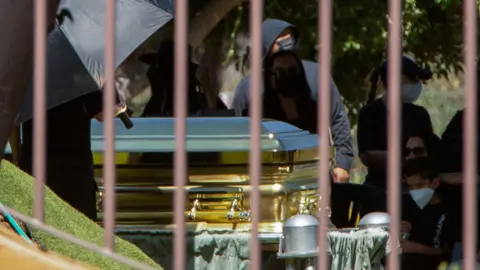


Reuters Mourners - some of them wearing surgical masks - look on as a gold-coloured casket containing the body of cartel leader Nemesio Oseguera Cervantes, known as "El Mencho," is displayed during his funeral at the Recinto de la Paz cemetery in Zapopan, Mexico,  on 2 March, 2026.Reuters
Some mourners concealed their identities with face masks

Infamous Mexican drug lord Nemesio Oseguera Cervantes, also known as "El Mencho", was buried in a golden casket by his family on Monday.

The cartel leader died after being wounded in a firefight between his bodyguards and Mexican special forces personnel deployed to capture him in late February.

The 59-year-old founder of the feared Jalisco New Generation Cartel (CJNG) was the country's most-wanted man, while the US had offered a $15m (£11.2m) reward for information leading to his arrest.

His death triggered widespread retaliatory violence in which cartel members set fire to vehicles and blockaded roads across 20 Mexican states.

Members of the National Guard were out in force to prevent fresh violence from breaking out during the colourful funeral near Guadalajara in Jalisco state, a stronghold for the cartel.

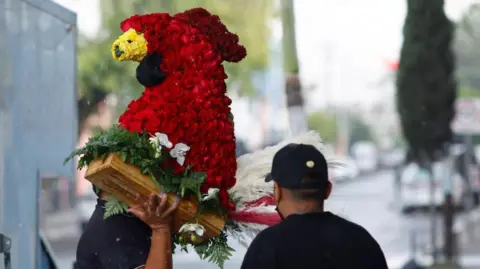
Large floral tributes were seen being carried into the funeral home ahead of the ceremony, including one shaped like a rooster in a reference to his love of cockfighting.
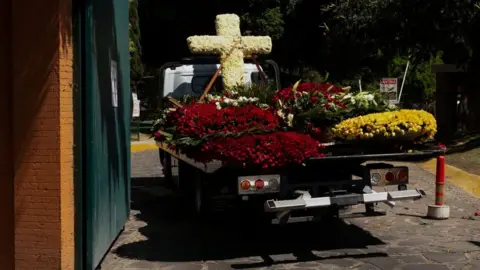
Reuters A truck transporting a flower‑covered cross enters the Recinto de la Paz cemetery, where, according to local media, the body of cartel leader Nemesio Oseguera Cervantes, known as “El Mencho,” who was killed on February 22 in a military operation in the state of Jalisco, was brought following his wake, in Zapopan, Mexico, March 2, 2026.Reuters
Several vehicles were required to transport colourful arrangements to the cemetery
Francisco Guasco/EPA/Shutterstock A person carries a floral arrangement during the wake of Nemesio Oceguera Cervantes, alias El Mencho, leader of the Jalisco New Generation Cartel (CJNG), in Guadalajara, Mexico, 01 March 2026 (Issued 02 March 2026). Francisco Guasco/EPA/Shutterstock
A rooster-shaped tribute was among the floral arrangements, many of which were reportedly received from unnamed senders

According to AFP news agency, five lorries were needed to take all the tributes to the cemetery, most of which had been sent anonymously.

The funeral procession was accompanied by a band playing ranchero music and narcocorridos - songs praising drug lords.

The traditional song El Muchacho Alegre (The Cheerful Boy) was played as Oseguera's gold-coloured coffin arrived at a chapel located inside the cemetery grounds, local media reported.

After an hour-long ceremony, the mourners - many of whom concealed their identities using face masks - followed the coffin as it was carried to the grave.

Mexican media noted that the plot was relatively plain compared with those of other drug lords, which are often topped by large mausoleums.
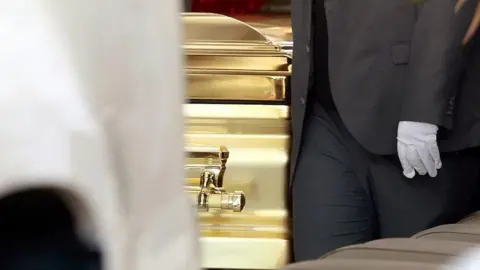
Ulises Ruiz/AFP via Getty Image A funeral employee carries the coffin of drug trafficker Nemesio "El Mencho" Oseguera at La Paz funeral home in Guadalajara, Jalisco state, Mexico, on March 2,Ulises Ruiz/AFP via Getty Image
The drug lord was buried in Jalisco state late on Monday

Under Oseguera's leadership, the CJNG became a powerful transnational criminal organisation which spread from its stronghold in Jalisco into many other Mexican states, where it engages in drug production and trafficking.

Oseguera's killing by Mexican special forces has been seen as a victory for President Claudia Sheinbaum's government, which has come under increasing pressure by her US counterpart Donald Trump to do more to combat drug trafficking.

But there have been fears that the vacuum left behind by the powerful cartel leader could trigger a surge in violence in the short term, as different factions within the criminal group - which is estimated to have tens of thousands of members - fight for control.

Comments

Popular posts from this blog

Who Was the Real Marilyn Monroe?

  From - Smithsonian Magazine, By -  Grant Wong Historian, University of South Carolina, Edited by - Vinuri Randhula  Silva, “Blonde,” a heavily fictionalized film by Andrew Dominik, explores the star’s life and legend in a narrative that’s equal parts glamorous and disturbing Marilyn Monroe’s  final interview  is a heartbreaker. Published in  Life  magazine on August 3, 1962—just a day before the  actress died  of a barbiturate overdose at age 36—it found Monroe reflecting on her celebrity status, alternatively thoughtful, frank and witty. “When you’re famous you kind of run into human nature in a raw kind of way,” she observed. “It stirs up envy, fame does. People you run into feel that, well, who is she—who is she, who does she think she is, Marilyn Monroe?” That same question—who was the real Monroe?—has sparked debate among  cinema scholars ,  cultural critics ,  historians ,  novelists ,  filmmakers  and th...

New Comet SWAN Now Visible in Small Scopes

     From :- Sky & Telescope  By :- Bob King  Edited by :- Amal Udawatta This spectacular image of Comet SWAN (C/2025 F2) was taken on April 6th and shows a bright, condensed coma 5′ across and dual ion tails. The longer one extends for 2° in PA 298° and the other 30′ in PA 303°. Details: 11"/ 2.2 RASA and QHY600 camera. Michael Jaeger Amateur astronomers have done it again — discovered a comet. Not by looking through a telescope but through close study of  publicly released, low-resolution images  taken by the  Solar Wind Anisotropies  (SWAN) camera on the orbiting  Solar and Heliospheric Observatory  (SOHO). On March 29th, Vladimir Bezugly of Ukraine was the first to report a moving object in SWAN photos taken the week prior. Michael Mattiazzo of Victoria, Australia, independently found "a pretty obvious comet" the same day using the same images, noting that the object was about 11th magnitude and appeared to be brightening. R...

Geckos shed around every month in adulthood

 From -Earth Unreal, Edited -by Vinuri Randula Silva, All geckos shed their skin at fairly regular intervals, with different species differing in timing and method. When shedding begins, geckos accelerate the process by detaching the loose skin from their body and eating it.   Geckos shed around every month in adulthood, and will often eat their shed skin. This is to gain back some of the nutrients they lose by shedding, and also to avoid being detected by predators in the wild.