From:- BBC World News
By :- Kamala Thiagarajan
Editted by :- Amal Udawatta
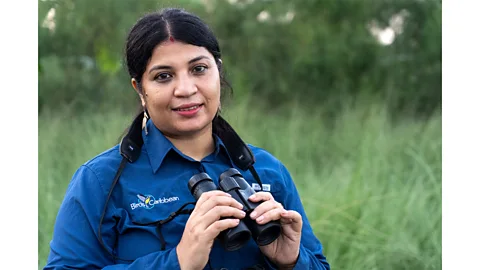
On a bright, sweltering January afternoon in 2007, biologist Purnima Devi Barman found herself in Dadara village, on the banks of India's mighty Brahmaputra River in the northeastern state of Assam. Despite being surrounded by tropical evergreen forests and emerald wetlands, all she could think about was the monumental destruction she was witnessing.
Local villagers had just hacked away at one of the tallest, most beautiful trees she had ever known – a local species of evergreen known as a kadamba. Now, amidst the tree's fallen branches, scattered leaves, twigs and thatches of nesting material lay large birds with black and white feathers, long limbs and sharp beaks, their dead bodies splayed on the ground.
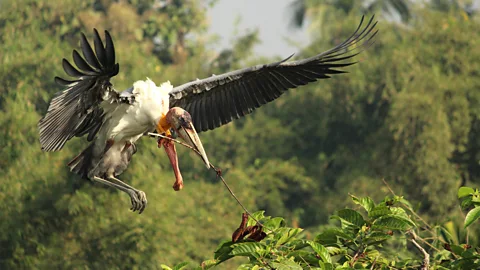
They were greater adjutant storks, one of Assam's most distinctive – and endangered – birds.
A few chicks were still alive, and Barman had picked up a baby bird and held it close to her chest. "I could feel its heart beating, and I could sense its pain and suffering," she remembers. As a mother raising young twins, the baby bird's trauma affected her deeply.
 Hargila Army
At the time, Barman was working towards a PhD in wildlife conservation, particularly studying the storks. But she knew that what she had just witnessed would change the course of her professional life. "I felt like I had to do something more than just observe these birds," she says. "They needed help."
Known locally as the hargila (or "bone-swallower") for its scavenging ways, greater adjutant storks are unique birds. Roughly 5ft (1.5m) tall, they aren't only imposing but also play a vital role in maintaining the health of a wetland ecosystem. As scavengers that consume and clean up carcasses, they prevent the spread of disease and break down decaying organic matter, recycling essential nutrients back into the soil.
Once abundant across Asia, today these birds can only be found in the northern Indian states of Assam and Bihar, as well as in pockets of Cambodia. The destruction of their nests and wetland habitats, human persecution such as hunting and egg collecting has severely impacted their population. The International Union for the Conservation of Nature (IUCN) classifies the bird as Near Threatened.
For years, villagers in Assam considered the storks a nuisance and a symbol of bad luck. They were feared, reviled and in some communities, hunted for their meat which was once widely used in folk medicine as a cure for leprosy or antidote to poison. The storks' habit of nesting on private property and their messy droppings made the situation worse.
 Rachele Bowen
Combined, these hurdles could have led greater adjutant storks to fade away completely, if it weren't for a group of local women, now numbering 20,000, who burst onto the scene and changed the fate of the storks. And while it continues to be a species of concern, persistent nurturing and conservation efforts have brought hope – and measurable success. In Assam, the birds have been spotted in eight regions and the IUCN estimates their numbers to be around 1,800, up from 450 birds in the state in 2007.
The all-women Hargila Army
For her doctoral research, Barman, who hails from Assam's Kamrup region, chose to study the greater adjutant stork's habits closely and observe their role in preserving the health of the wetlands. But after realising how hated, feared and endangered the birds were, she realised there was work to be done far beyond the science.
She set out to change the hargila's fearsome reputation. To build empathy for the birds, she started with an image makeover – she spoke admiringly of the birds and insisted that they weren't ill-omened.
She knew, though, she couldn't do it alone. In 2007, that same year she watched the kadamba tree be felled, she began going from village to village, home to home, speaking with the women in the community. Barman asked them to imagine how they would feel if their own babies were treated the same way as the hargila. For many, her calm reasoning struck a chord.
Pratima Kalita Rajbongshi, a 35-year-old mother of two daughters, says she remembers a time when the villagers would gather and throw pebbles at the birds. In 2009, when her second child was six months old, she attended a meeting arranged by Barman.
What they discussed made a deep impression on her. "Purnima ma'am said when our babies are sick, we take care of them, but we torture the bird and its babies. I just couldn't stop thinking about that. That was the day I decided to become an active member of the Hargila Army."
 Hargila Army
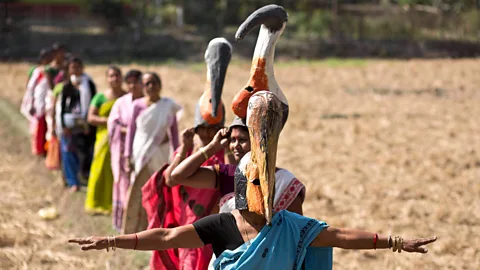
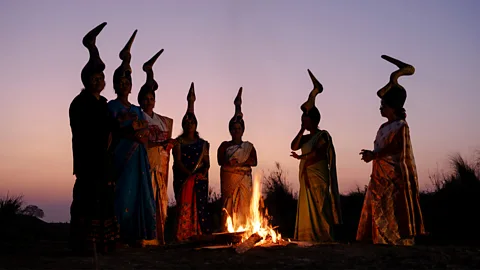
Members of the Hargila Army placed birds at baby showers – traditional Assamese celebrations that function as a prayer for a pregnant woman's health and long life. Women in handmade bird costumes, with the hargila's enormous beak towering over their heads, began to dance at these ceremonies. The birds were soon associated with these joyous occasions.
Barman began to form small community groups, seeking out women from the villages who could sew, paying them to weave the hargila's image onto hand woven sarees, cushion covers, quilts and shawls. Cooking competitions followed.
In this way, the all-female conservation initiative started slowly, with just a few women in the earlier days, Barman says. But support for the hargila from local women soon grew and then began to snowball. Today, the Hargila Army includes 20,000 women from 47 villages – all of whom have signed a pledge to protect the bird, she says.
Women were not previously active in public spaces, says Rajbongshi, but activities of the army attracted them and soon they began to use the hargila to express themselves in creative ways. "In protecting the birds, the local women found their own sense of identity and livelihoods too," she says.
Lavita Baishya, a 41-year-old mother who lives in Dadara, joined the Hargila Army's community groups in 2017. "We were taught folk songs that told us how to respect the bird, even revere it," she says.
It was also here among her peers that she discovered her love for sewing and embroidery. With the proceeds from her sewing, she eventually bought two sewing machines and opened her own tailoring centre in 2023, where she now trains other women, specialising in making hargila-themed textile merchandise. The Hargila Army now has a mobile cart that regularly sells themed merchandise door to door. There’s a retail outlet that opened in 2023 in Deepor Beel, a freshwater lake and wetland on the outskirts of Guwahati in Assam, and an online store. All proceeds from these sales go to the women.
Like Baishya, there are now seven teachers, all experienced hands at sewing, who train the others. They also learn about the environment in these training sessions, says Barman. Sales of the merchandise boomed and so did local pride in the rare bird.
Comments
Post a Comment