From - BBC World News
By - Justin Rowlatt , Climate Editor
Editted by - Amal Udawatta
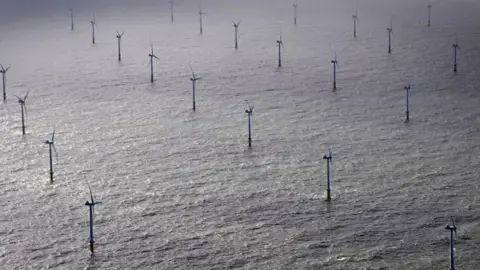
The UK is set to back a vast new fleet of offshore wind projects in the North Sea alongside nine other European countries including Norway, Germany and the Netherlands.
The government says the deal will strengthen energy security by offering an escape from what it calls the "fossil fuel rollercoaster".
For the first time, some of the new wind farms will be linked to multiple countries through undersea cables known as interconnectors, which supporters say should lower prices across the region.
But it could prove controversial as wind farm operators would be able to shop around between countries to sell power to the highest bidder - potentially driving up electricity prices when supply is tight.
Energy Secretary Ed Miliband will sign a declaration on Monday at a meeting on the future of the North Sea in the German city of Hamburg, committing to complete the scheme by 2050.
Jane Cooper, deputy CEO of industry body RenewableUK, said the deal would "drive down costs for billpayers" as well as increasing "the energy security of the UK and the whole of the North Sea region significantly".
But Claire Countinho, shadow energy secretary, warned "we cannot escape the fact that the rush to build wind farms at breakneck speed is pushing up everybody's energy bills."
 National Grid
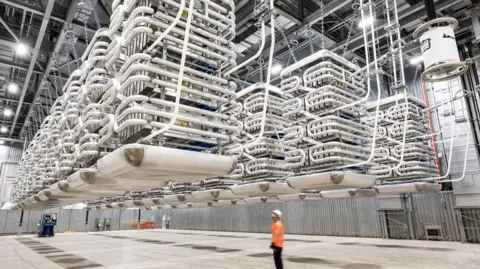
A network of undersea cables already connect the electricity grids of European countries - the UK has 10 such cables - but connecting wind farms directly to multiple countries will be a first.
Most energy economists agree more connections between the UK and other European grids should reduce costs and improve the security of supply.
The UK National Grid published a paper earlier this month suggesting such an arrangement could cut so-called constraint payments, made when wind farms are asked not to generate power because the electricity network is too congested.
A separate report said UK consumers had enjoyed savings of £1.6bn from the nine existing undersea cables linking the UK with Europe since 2023.
National Grid said the cables help smooth spikes in prices because, thanks to time zone differences, surplus energy generated off-peak elsewhere can be sold cheaply to the UK.
But interconnectors have proved controversial in Norway where there have been concerns that selling power to foreign countries could reduce supplies for Norwegian customers and therefore increase the price they pay.
To stop this happening, the government brought in new rules to restrict electricity exports when domestic supply could be at risk.
Norway also refused permission for a new interconnector to Scotland.
Nato and the European Commission are also taking part in the summit, which is expected to include pledges to strengthen security for offshore energy infrastructure amid rising concerns over sabotage and unsafe maritime activity.
The agreement underlines Europe's continued commitment to wind power, despite renewed criticism from US President Donald Trump, who again attacked what he called "windmills" during a speech at the World Economic Forum in Davos.
The North Sea countries pledged to develop 300 gigawatts (GW) of offshore wind capacity three years ago. This new deal means 100GW of the total will be built jointly. It is expected to say 20GW of that should be under way by 2030.
China currently leads the world in offshore wind, with 43GW of the world's 83GW of installed capacity, according to a report last year from industry body RenewableUK.
The UK ranks second, with almost 16GW already in operation. The UK government has awarded contracts for a further 20GW, including 8.4GW agreed in a record-breaking bidding round earlier this month.
The government was criticised by the Conservatives for "locking in" high offshore wind prices.
Reform has also repeatedly attacked the cost of net zero, but the Lib Dems and Greens both support the expansion of renewables to tackle the threat of climate change and boost green jobs.
SNP and Plaid Cymru also support the growth of offshore wind, but argue Scotland and Wales should have control of their energy resources.
Additional reporting by Miho Tanaka.
Comments
Post a Comment