From:- Sky & Telescope
By :- J. Kelly Beatty
Editted by :- Amal Udawatta
We’ll want to make good on that pledge right away, because our first opportunity occurs early in January, with the arrival of the Quadrantid meteor shower. These meteors get their name from Quadrans Muralis, an obsolete constellation near the handle of the Big Dipper. Unfortunately this year the peak arrives in the Americas on the afternoon of January 3rd — and there’s a full Moon that night. Bummer!
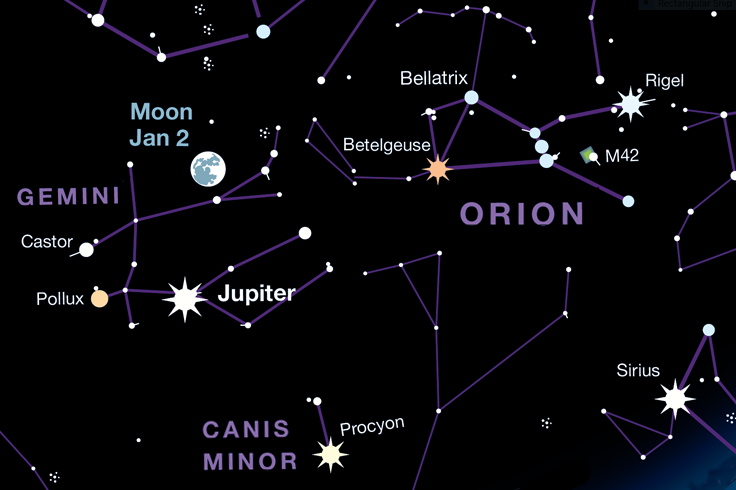
Of the five planets visible by eye, three of them — Mercury, Venus, and Mars — are bunched closely together very close to the Sun in the sky and thus out of view this whole month. That leaves Jupiter and Saturn to entertain us. Right now Saturn is fairly high in the southwest after even twilight fades. Meanwhile, Jupiter reaches what’s called opposition on January 9th (that is, it appears opposite the Sun in our sky). This is when Jupiter appears its closest to Earth. And, wow, it’s dazzlingly bright after it rises in the east in early evening.
The evening skies of January feature an incredible array of bright stars — more so than at any other time of the year. An obvious asterism is the five-star zigzag of Cassiopeia. It looks like a squashed W in summertime, and like a flattened M in winter, when it’s almost straight up. In Greek mythology, Cassiopeia was a queen in what’s now Ethiopia and also the mother of Andromeda. This mythical queen boasted that she and her daughter were more beautiful than all the Nereids, the nymphy daughters of the sea god Nereus. This was not a good idea.
Over in the east, you’ll see the stars of Orion, the Hunter, striding up from the horizon early on January evenings. In Greek mythology, Orion was a gigantic, supernaturally strong hunter pursued the Pleiades (all daughters of Atlas) relentlessly, and to escape him, Zeus transformed them into stars. Today that chase continues eternally across the heavens.
In Orion’s midsection, look for a trio of bright stars in a vertical row. These mark the hunter’s belt — yet another asterism — and there’s nothing else like them anywhere in the sky. To the belt’s upper left is the bright star Betelgeuse, which marks Orion’s shoulder. On the right side of the Belt is Orion’s other really bright star, Rigel. Can you see a color difference between them? To get the details, download or stream this month’s Sky Tour episode.
In fact, Sky Tour gives you all of these celestial highlights — and many more — in a fun and entertaining 15-minute romp across the night sky. So bundle up, grab your curiosity, and come along on this month’s Sky Tour.
Comments
Post a Comment