The Subaru Telescope just made its 1st discoveries: a 'failed star' and an exoplanet

  From:- Space.com 

  By 

  Edited by: Amal Udawatta


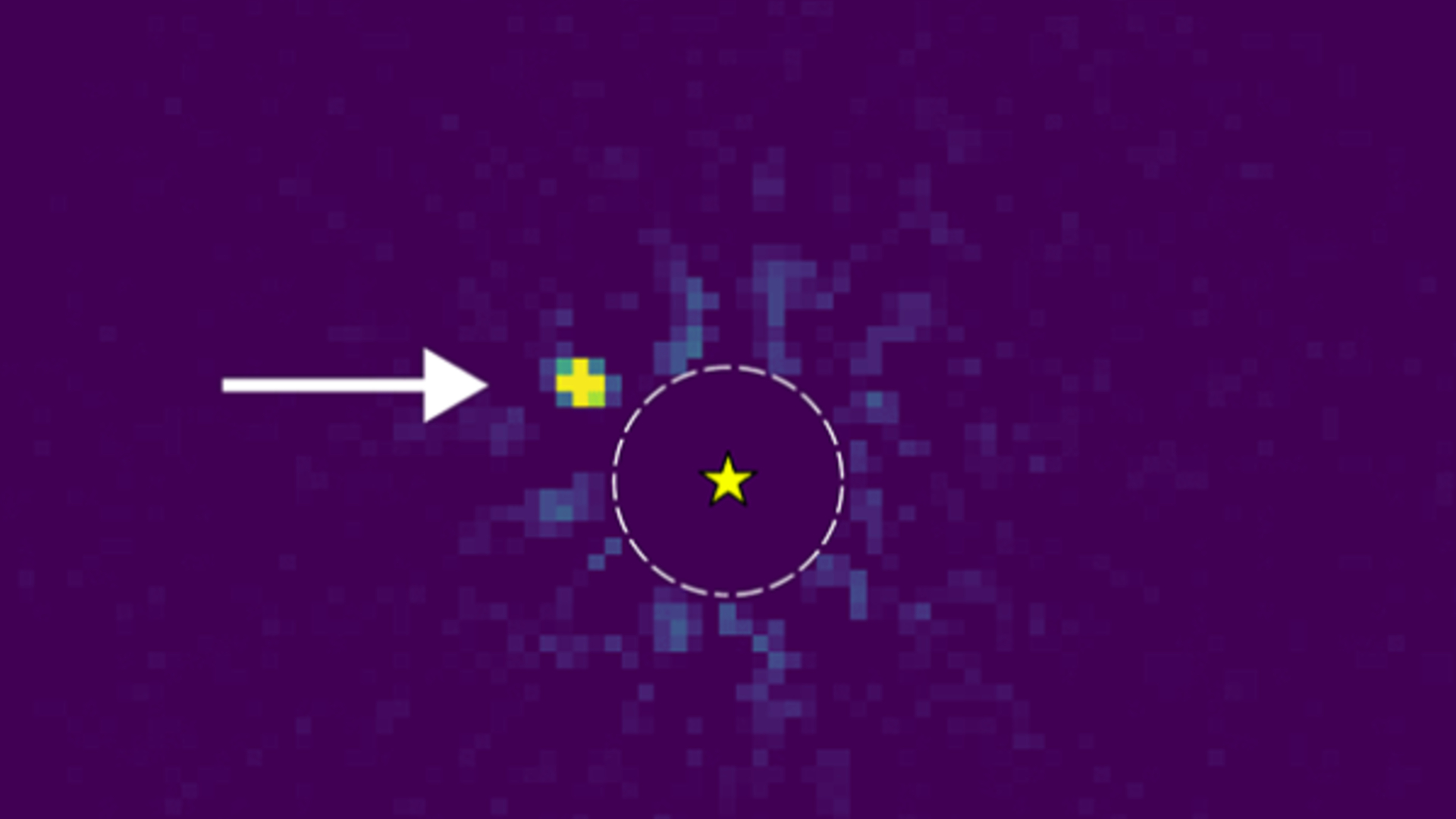
A heat map with a purple background and yellow dots showing an exoplanet
A photo from the Subaru Telescope in Hawaii. (Image credit: T. Currie/Subaru Telescope, UTSA)

While our ability to view distant worlds with advanced telescopes has come a long way in a short time, we can still only photograph a tiny fraction of the planets throughout our cosmos with the technology we have today.

However, astronomers in Hawaii just spotted a pair of exciting discoveries — a huge exoplanet and a brown dwarf — using Japan’s Subaru Telescope, which sits atop Mauna Kea, a dormant volcano on the Big Island of Hawaii.

The exoplanet that the astronomers found is called HIP 54515 b. It's 271 light-years away from Earth and orbits a star in the Leo constellation. NAOJ says the planet is almost 18 times the mass of Jupiter and that it orbits its star from a vantage point that’s roughly the same as Neptune's distance from the sun.
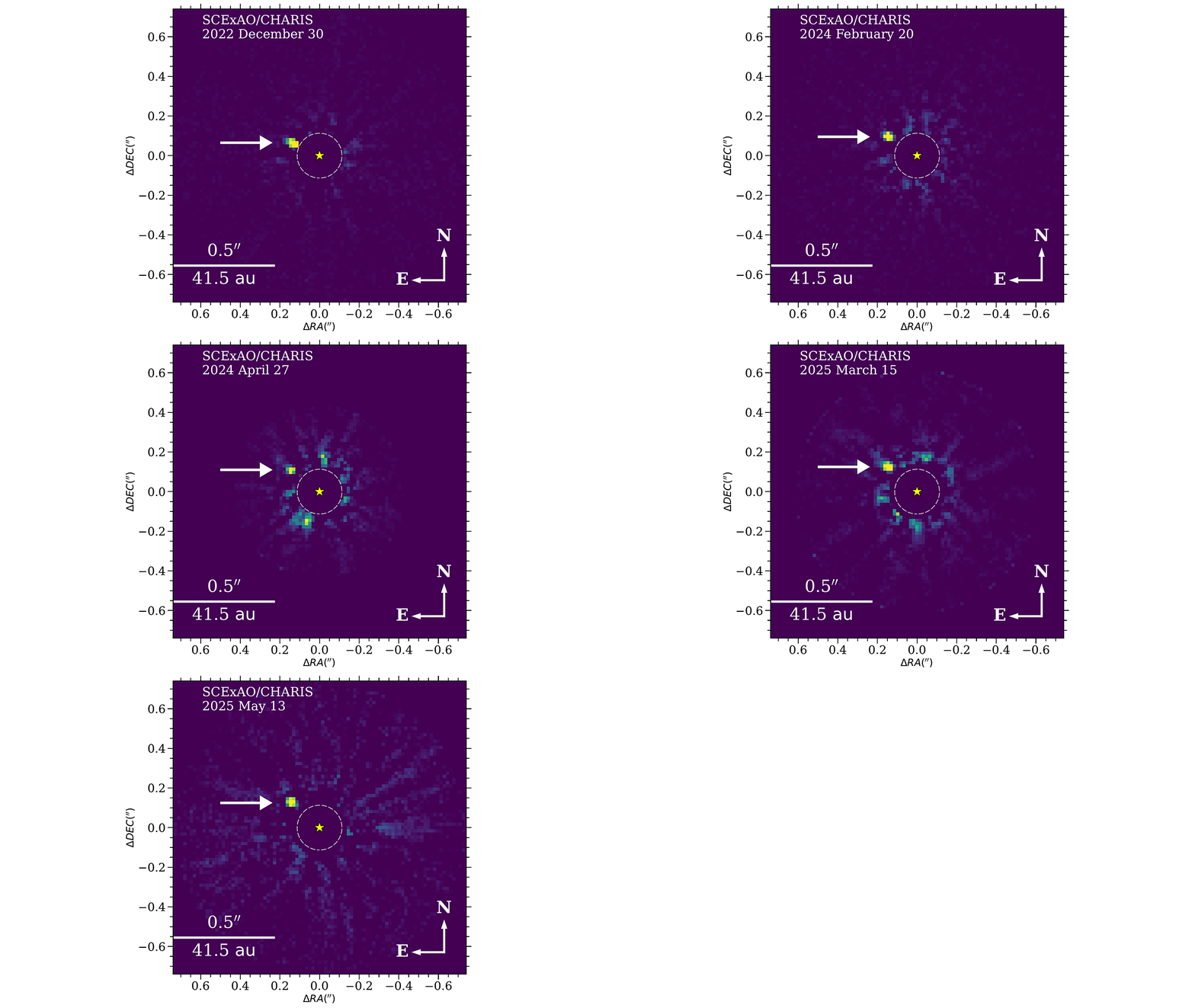
This gif shows the exoplanet the Subaru Telescope found. (Image credit: T. Currie/Subaru Telescope, UTSA)

The brown dwarf, called HIP 71618 B, is 169 light-years away in the Bootes constellation. The term "brown dwarf" refers to a curious celestial object that has a mass somewhere between a planet and a star. Scientists often call brown dwarfs "failed stars," because these objects form in a similar way to stars but never accumulate quite enough mass to make the cut.

The discovery of the brown dwarf is especially exciting, because it has the right properties to test out NASA's new Nancy Grace Roman Space Telescope, which will launch in 2026 or 2027.

To test the Roman Space Telescope, NASA needs an object with pretty tight specifications. NAOJ says this brown dwarf checks all the boxes. "Roman will carry out a technology demonstration to test coronagraph systems that future telescopes will need to photograph Earth-like planets around other stars — planets that are ten billion times fainter than their host stars," NAOJ wrote.

A large round metal building sits atop a cliffside with clouds in the distance

The Subaru Telescope is located in Mauna Kea Hawaii. (Image credit: International Gemini Observatory/NOIRLab/NSF/AURA)

So, with this new discovery, NAOJ says, Roman will have the right candidate for a technology demonstration.

Comments

Popular posts from this blog

New Comet SWAN Now Visible in Small Scopes

     From :- Sky & Telescope  By :- Bob King  Edited by :- Amal Udawatta This spectacular image of Comet SWAN (C/2025 F2) was taken on April 6th and shows a bright, condensed coma 5′ across and dual ion tails. The longer one extends for 2° in PA 298° and the other 30′ in PA 303°. Details: 11"/ 2.2 RASA and QHY600 camera. Michael Jaeger Amateur astronomers have done it again — discovered a comet. Not by looking through a telescope but through close study of  publicly released, low-resolution images  taken by the  Solar Wind Anisotropies  (SWAN) camera on the orbiting  Solar and Heliospheric Observatory  (SOHO). On March 29th, Vladimir Bezugly of Ukraine was the first to report a moving object in SWAN photos taken the week prior. Michael Mattiazzo of Victoria, Australia, independently found "a pretty obvious comet" the same day using the same images, noting that the object was about 11th magnitude and appeared to be brightening. R...

Why did Homo sapiens outlast all other human species?

  From - Live Science By  Mindy Weisberger Edited by - Amal Udawatta Reproductions of skulls from a Neanderthal (left), Homo sapiens (middle) and Australopithecus afarensis (right)   (Image credit: WHPics, Paul Campbell, and Attie Gerber via Getty Images; collage by Marilyn Perkins) Modern humans ( Homo sapiens ) are the sole surviving representatives of the  human family tree , but we're the last sentence in an evolutionary story that began approximately 6 million years ago and spawned at least 18 species known collectively as hominins.  There were at least nine  Homo  species — including  H. sapiens  —  distributed around Africa, Europe and Asia by about 300,000 years ago, according to the Smithsonian's  National Museum of Nat ural History  in Washington, D.C. One by one, all except  H. sapiens  disappeared.  Neanderthals  and a  Homo  group known as the  Denisovans  lived alongside...

Who Was the Real Marilyn Monroe?

  From - Smithsonian Magazine, By -  Grant Wong Historian, University of South Carolina, Edited by - Vinuri Randhula  Silva, “Blonde,” a heavily fictionalized film by Andrew Dominik, explores the star’s life and legend in a narrative that’s equal parts glamorous and disturbing Marilyn Monroe’s  final interview  is a heartbreaker. Published in  Life  magazine on August 3, 1962—just a day before the  actress died  of a barbiturate overdose at age 36—it found Monroe reflecting on her celebrity status, alternatively thoughtful, frank and witty. “When you’re famous you kind of run into human nature in a raw kind of way,” she observed. “It stirs up envy, fame does. People you run into feel that, well, who is she—who is she, who does she think she is, Marilyn Monroe?” That same question—who was the real Monroe?—has sparked debate among  cinema scholars ,  cultural critics ,  historians ,  novelists ,  filmmakers  and th...