Astronomers discover 2nd fastest asteroid in the solar system hiding in the sun's glare

   From- Space.Com

  By  

  Edited by - Amal Udawatta

a white blurry dot on a black starry background
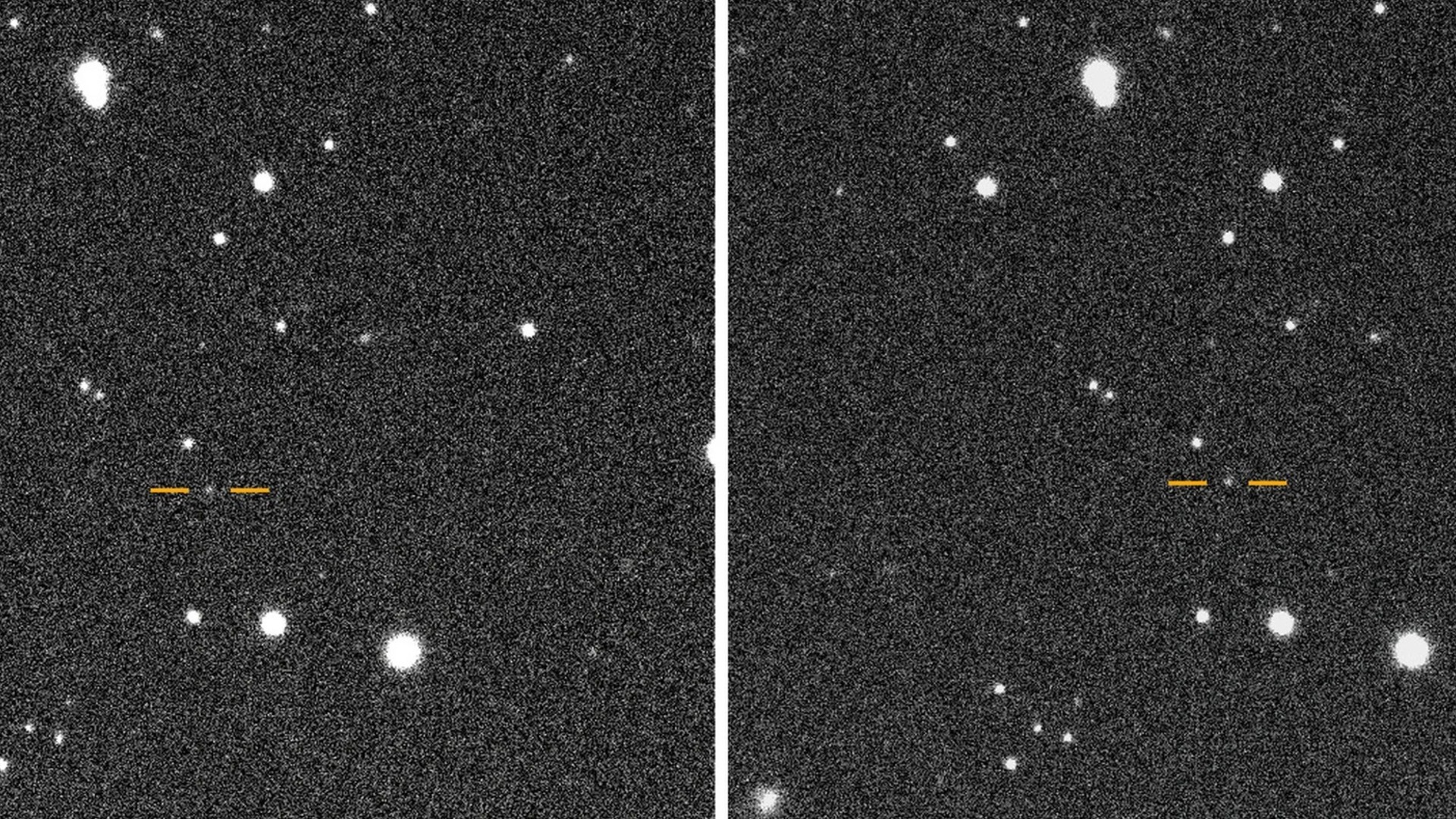
Images from the night of 2025 SC79's discovery showing its motion relative to background stars. (Image credit: Scott S. Sheppard)

A newly found space rock almost broke a speed record.

The asteroid, called 2025 SC79, has a pathway within the orbit of Venus that zips around the sun in only 128 days, making it the second-fastest unique asteroid orbit in the solar system, according to a statement from Carnegie Science. 2025 SC79 is also a pretty big asteroid: roughly 0.4 miles (700 meters) long, or roughly the length of a skyscraper.

Carnegie astronomer Scott Sheppard, a noted discoverer of small moons around Jupiter, Saturn, Uranus and Neptune, spotted the asteroid on Sept. 27 hiding in the sun's glare. While 2025 SC79 will make no close approaches to Earth for the foreseeable future, finding hidden asteroids is essential for protecting our planet, Sheppard emphasized in the statement. "The most dangerous asteroids are the most difficult to detect," Sheppard said. "Most asteroid research finds these objects in the dark of night, where they are easiest to spot. But asteroids that lurk near the sun can only be observed during twilight—when the sun is just about to rise or set. If these 'twilight' asteroids approach Earth, they could pose serious impact hazards."

Sheppard and his team also previously found the fastest-known asteroid, 2021 PH27, which circles the sun in only 113 days — less than a third of a year on Earth. His research into twilight asteroids, which includes financial support from NASA, uses the Dark Energy Camera at the National Science Foundation's (NSF) Víctor M. Blanco 4-meter telescope in Chile.

The new asteroid was confirmed by NSF's Gemini Observatory (which has locations in Hawaii and Chile) as well as Carnegie Science's twin Magellan Telescopes in Chile. News of 2025 SC79's discovery was brought to the astronomy community Oct. 15 in a circular from the Minor Planet Center, a branch of the International Astronomical Union that shares information on small, natural bodies in space.

Follow-up observations of 2025 SC79 will need to wait several months as it is now behind the sun, from Earth's perspective. "Future research of this object will reveal details about its composition—and how it survives the intense heat of its proximity to the Sun—as well as its possible origin," Carnegie officials stated.

Sheppard added following up observations of this type of asteroid has a lot of merit, because it helps astronomers understand how perturbations in small-body orbits, caused by gravity of other objects like planets, can make the pathway veer over the eons. "Understanding how they [asteroids] arrived at these locations can help us protect our planet, and also help us learn more about solar system history."

Astronomers keep close watch on asteroids in the sky, including "potentially hazardous" asteroids that in the statistical sense, are deemed a little more worrisome. After decades of careful searching, however, no imminent threats to our planet have been found.

NASA and a network of telescopes keep searching just in case—with the work being deemed so essential that findings continue to be published this month despite the ongoing U.S. government shutdown.


Comments

Popular posts from this blog

Who Was the Real Marilyn Monroe?

  From - Smithsonian Magazine, By -  Grant Wong Historian, University of South Carolina, Edited by - Vinuri Randhula  Silva, “Blonde,” a heavily fictionalized film by Andrew Dominik, explores the star’s life and legend in a narrative that’s equal parts glamorous and disturbing Marilyn Monroe’s  final interview  is a heartbreaker. Published in  Life  magazine on August 3, 1962—just a day before the  actress died  of a barbiturate overdose at age 36—it found Monroe reflecting on her celebrity status, alternatively thoughtful, frank and witty. “When you’re famous you kind of run into human nature in a raw kind of way,” she observed. “It stirs up envy, fame does. People you run into feel that, well, who is she—who is she, who does she think she is, Marilyn Monroe?” That same question—who was the real Monroe?—has sparked debate among  cinema scholars ,  cultural critics ,  historians ,  novelists ,  filmmakers  and th...

New Comet SWAN Now Visible in Small Scopes

     From :- Sky & Telescope  By :- Bob King  Edited by :- Amal Udawatta This spectacular image of Comet SWAN (C/2025 F2) was taken on April 6th and shows a bright, condensed coma 5′ across and dual ion tails. The longer one extends for 2° in PA 298° and the other 30′ in PA 303°. Details: 11"/ 2.2 RASA and QHY600 camera. Michael Jaeger Amateur astronomers have done it again — discovered a comet. Not by looking through a telescope but through close study of  publicly released, low-resolution images  taken by the  Solar Wind Anisotropies  (SWAN) camera on the orbiting  Solar and Heliospheric Observatory  (SOHO). On March 29th, Vladimir Bezugly of Ukraine was the first to report a moving object in SWAN photos taken the week prior. Michael Mattiazzo of Victoria, Australia, independently found "a pretty obvious comet" the same day using the same images, noting that the object was about 11th magnitude and appeared to be brightening. R...

Best Double Stars in the Pleiades Cluster

    From -Sky & Telescope By - Bob King  Edited by- Amal Udawatta         The dipper-shaped Pleiades cluster (M45) is also called the Seven Sisters and named for the mythological seven daughters of Atlas and Pleione. The young cluster is between 75 and 150 million years and lies 444 light-years from Earth. Jared-Bowens The Pleiades star cluster is one of the night sky's best-known astronomical sights. Alluring to the naked eye, it's even more amazing through binoculars or a small telescope, both of which reveal dozens more stars. As the cluster plows through space at 6 kilometers per second (13,400 mph), its hot, youthful suns illuminate a happenstance interstellar cloud, turning it into a gossamer nebula that temporarily enshrouds the stellar bunch. Additional treasures lie within its bounds: There are also about a half-dozen double and multiple stars within the Pleiades. You might already be familiar with 2.9-magnitude Alcyone, a choice triple st...